

Beyond the Logo: The Science of Identity Align-ment for High-Achieving Leaders
Your logo is beautiful. Your visual identity is cohesive. Your brand guidelines exist in a pristine PDF somewhere in your drive. And yet something feels off. Perhaps you've built an empire on metrics and momentum, only to realize the brand you've created doesn't quite capture who you've become. Or maybe you're leading at a level that demands a different kind of presence: one that goes far deeper than aesthetic consistency. This is the territory where high-achieving leaders often find themselves: caught between the identity they've constructed and the one they're actually inhabiting.
The gap between your internal brilliance and your external brand isn't a design problem. It's an alignment problem. And the science behind closing that gap is more precise: and more powerful: than you might think.
The Performance Trap
High-achieving leaders face a particular vulnerability that rarely gets discussed in boardrooms or brand strategy sessions. You've built influence through excellence, discipline, and relentless execution. But that same drive can create an invisible dependency on external validation: on the next milestone, the next metric, the next proof point that you belong at this level.

Research in organizational psychology confirms what many leaders experience privately: when your sense of identity relies primarily on performance outputs rather than internal coherence, you create unsustainable pressure. The cost shows up as burnout, decision fatigue, and a creeping sense that no achievement ever quite settles the question of your own authority.
This isn't imposter syndrome. It's structural misalignment. When your brand: the way you show up, communicate, and position yourself: isn't anchored in a clear leadership identity, you end up oscillating. You over-accommodate to maintain approval, or you over compensate with control to project confidence. Neither creates the kind of magnetic, consistent presence that defines next-level leadership.
What Identity Alignment Actually Means
Identity alignment isn't about finding yourself or following your passion. It's about integrating the pattern of who you are: your motivations, values, natural strengths, and psychological structure: into how you lead, decide, and influence. This is grounded, measurable work. The Identity Flywheel model illustrates the mechanism: a coherent leadership identity generates trust. Trust energizes intrinsic motivation. Motivation creates clarity and momentum. And that momentum reinforces your sense of calling, which deepens your identity further.
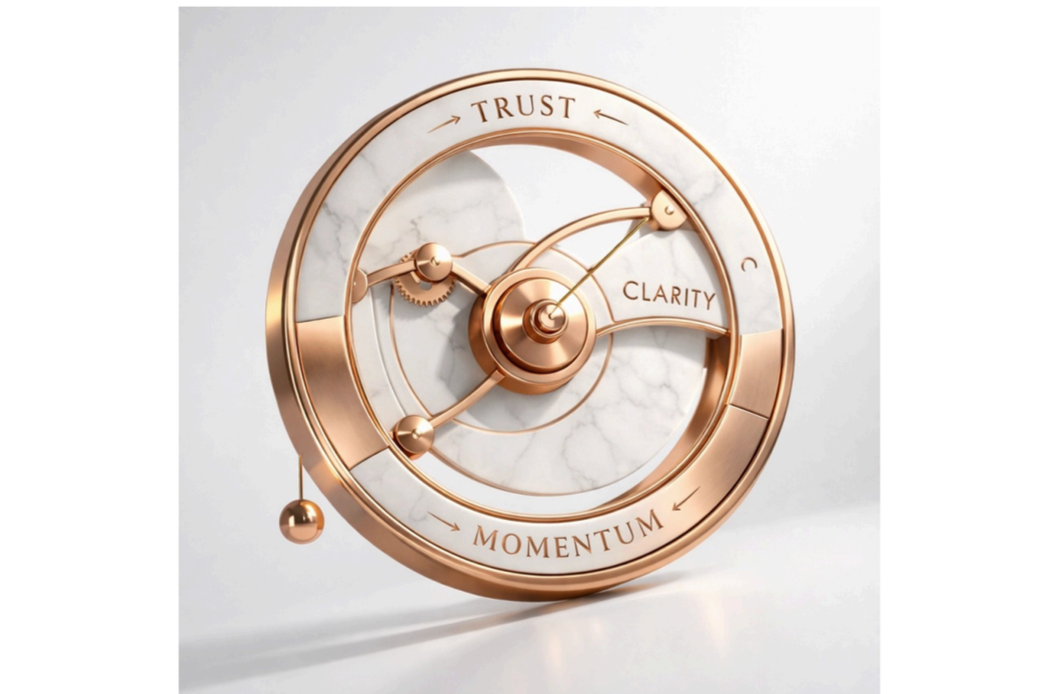
It's a self-reinforcing cycle, but only when the foundation is solid. Without that internal alignment, the flywheel stalls. You're constantly restarting, re-proving, repositioning. The effort never compounds. Identity leadership operates through a specific pathway: it fosters organizational identification that enhances relational energy and embeddedness. When you lead from a place of clarity rather than performance anxiety, your teams feel it. Psychological safety increases. Innovation accelerates. Trust doesn't have to be manufactured through control: it emerges naturally from coherence.
It's a self-reinforcing cycle, but only when the foundation is solid. Without that internal alignment, the
flywheel stalls. You're constantly restarting, re-proving, repositioning. The effort never compounds. Identity leadership operates through a specific pathway: it fosters organizational identification that enhances relational energy and embeddedness. When you lead from a place of clarity rather than performance anxiety, your teams feel it. Psychological safety increases. Innovation accelerates. Trust doesn't have to be manufactured through control: it emerges naturally from coherence.
This is where brand strategy intersects with behavioral science. Your external positioning: how you're perceived, how you communicate your value, what you're known for: must be rooted in your actual psychological structure. When there's congruence between your internal identity and your external brand, everything you do carries more weight. Your messaging lands with precision. Your presence feels effortless. Your influence scales without requiring more performance. Authentic identity alignment is structured, repeatable, and trainable. It's not "just be yourself." It's understanding the architecture of who you are and deliberately translating that into how you show up in every interaction, decision, and communication.
Moving Beyond Performative Leadership
The distinction matters here: identity alignment rejects performative vulnerability just as much as it rejects hustle culture posturing. This isn't about softening your edges or leading with endless introspection. It's about sharpening accountability with clarity rather than pressure. It's about grounding sustained influence in aligned action rather than reactive pivots based on whoever's watching.
Assessment tools: 360-degree feedback, strengths profiles, behavioral frameworks: function as mirrors. They reveal both your natural leadership patterns and your derailers. But awareness alone doesn't drive transformation. Integration does. The work is translating insight into structural changes in how you make decisions, build relationships, and position your authority. When your brand is aligned with your actual identity, you stop needing external validation to confirm your relevance. You lead from a place of internal coherence that others recognize immediately. It reads as confidence without arrogance. Clarity without rigidity. Presence without performance.
The Framework for Next-Level Positioning
If you're leading at a level where your brand needs to match the sophistication of your thinking, here's where to begin:
First, map your psychological architecture. Use rigorous assessment tools to understand your motivations, patterns, strengths, and blind spots. This isn't personality typing for fun: it's structural insight that informs every strategic decision you make about how to position yourself.
Second, audit your external brand for alignment. Look at how you communicate, the visual identity you project, the language you use to describe your work. Does it reflect the depth of who you actually are, or is it a version of you that felt safe five years ago? Brand evolution isn't about chasing trends: it's about ensuring your external positioning matches your internal evolution.
Third, build deliberate integration practices. Awareness without application creates intellectual understanding but no behavioral change. Work with a coach, advisor, or strategic partner who can help you translate psychological insight into how you show up in high-stakes moments. This is where identity becomes leadership.
Finally, let coherence replace performance. Stop measuring your brand by how much you're doing and start measuring it by how aligned it feels. When your identity, your messaging, and your positioning are in sync, influence becomes effortless. You're not performing authority: you're embodying it.

The Transformation Beyond the Logo
Your logo will never carry the weight of your leadership. Neither will your color palette, your tagline, or your social media presence. What carries weight is coherence. It's the alignment between who you are internally and how you show up externally. It's the integration of your brilliance into a brand that doesn't just look polished: it feels undeniable. This is the science of identity alignment: structured, strategic, and deeply personal. It's the work that separates leaders who perform influence from those who embody it. And it's the foundation for positioning yourself at the level your vision demands. If your brand feels like a beautiful shell that doesn't quite fit who you've become, you're not facing a design challenge. You're standing at the edge of identity transformation. The question isn't whether your logo is perfect. It's whether your leadership is aligned. And that's the work that changes everything.